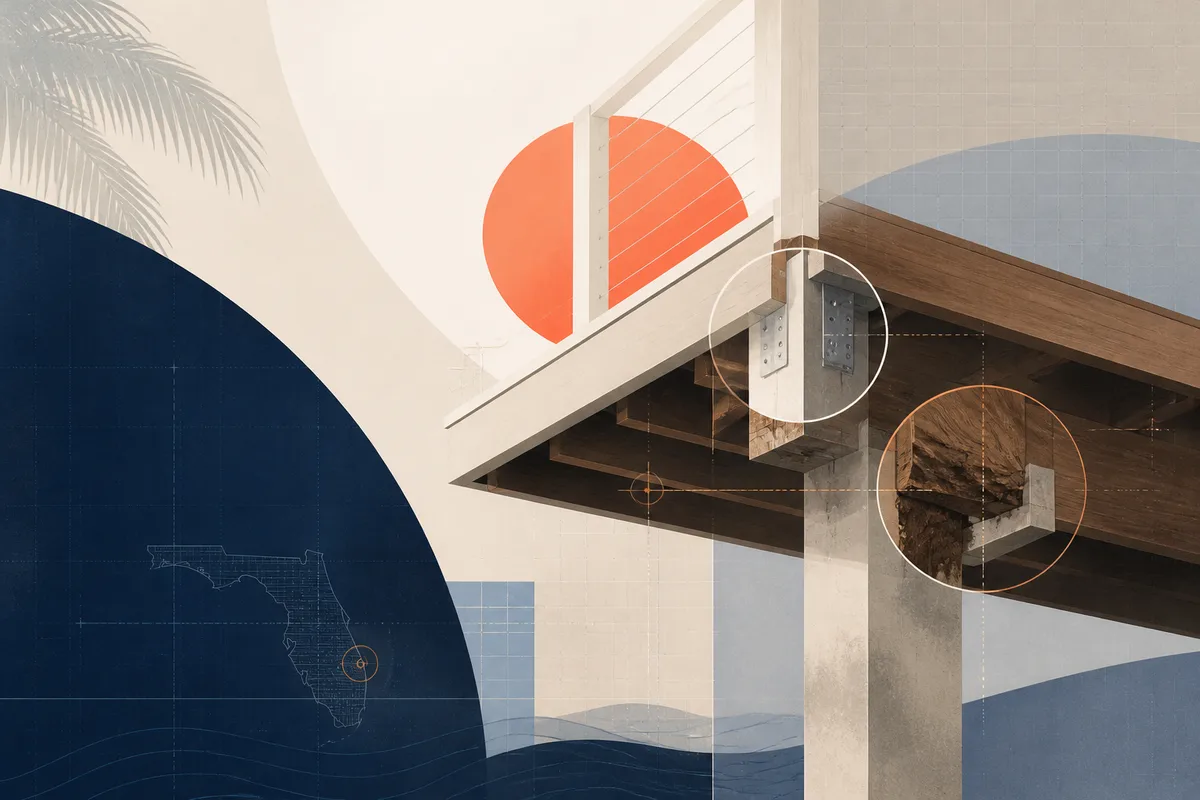
Identifying Structural Failure vs. Cosmetic Checking in Florida Decks
In the intense subtropical climate of the Tampa Bay area, pressure-treated pine is in a constant state of thermal expansion and contraction. Most homeowners mistake "checking"—the small, lengthwise cracks that appear as wood dries—for terminal damage, leading to unnecessary board replacements. Conversely, many ignore the early stages of cupping or rot, assuming a thick coat of stain will fix the issue.
This guide outlines the specific indicators of pressure treated wood uv damage signs and provides a diagnostic framework for assessing whether a deck requires maintenance or a structural rebuild. It is designed for property owners who need to make informed decisions about their outdoor living investments before seasonal rains exacerbate existing wood fatigue. For those considering long-term alternatives, Composite Decks offer different maintenance profiles.
Why UV exposure destroys pressure-treated pine
The sun acts as a catalyst for mechanical failure in wood through a process called photodegradation. While the chemical treatment protects against rot and termites, it offers little protection against the physical stresses caused by high-energy UV rays. According to culpeperwood.com, the sun's rays can cause wood to dry out and eventually lead to splitting or warping.
- UV rays break down the lignin that binds wood fibers together, causing the surface to become brittle and silver-gray.
- Rapid moisture evaporation from the top surface of the board causes it to shrink faster than the underside, which may remain damp.
- Differential drying creates internal tension that pulls the edges of the board upward, a process known as cupping.
- Sustained heat cycles in regions like the Brandon service area weaken the grip of fasteners, leading to protruding nails or screws.
The diagnostic playbook for wood fatigue
Identifying the severity of damage requires looking past the color of the wood to the physical orientation of the grain and the integrity of the board edges.
1Differentiate checking from splitting
Small cracks running parallel to the grain, known as checks, are common in pressure-treated pine and are a natural result of the wood seasoning process. However, according to contractexteriors.com, surface cracking and splitting are among the most common problems that require monitoring to ensure they do not compromise the board.
2Evaluate cupping and warping
Place a straightedge across the width of a deck board to see if the center is lower than the edges. If a board shows significant signs of warping or cupping, it can create a water trap that will accelerate damage to the wood and underlying structure.
3Evaluate splintering and fiber shedding
If wood fibers pull away easily, the surface has been degraded by environmental exposure. This texture is a precursor to deep splintering, which poses a safety risk for bare feet and indicates that the wood needs attention to maintain its durability.
4Inspect for rot and loose fasteners
Wood density and strength can change over time due to environmental stress. As noted by culpeperwood.com, owners should look for loose or rotting boards, protruding nails or screws, and any areas showing signs of water damage.
The mechanism of moisture-driven cupping
Cupping is rarely a result of just one factor; it is the interaction between high humidity and intense solar heat. When the sun beats down on the exposed face of a board, the moisture content on the top surface drops rapidly, while the underside, facing the damp soil or a shaded subframe, remains at a higher moisture level.
Because wood expands as it absorbs moisture and shrinks as it dries, the top of the board physically becomes narrower than the bottom. This force is strong enough to bend the wood against the resistance of fasteners, eventually leading to permanent deformation. Proper drying is essential, as staining too early can trap moisture, while staining too late exposes the wood to UV damage and cracking, according to deckrestorationplus.
How Deck Builders of Tampa helps
Professional deck assessments typically involve a comprehensive review of the substructure and surface condition to determine if a rebuild is necessary. A standard inspection includes checking for joist rot, verifying that footings haven't shifted, and determining if the current boards can be salvaged through maintenance. If the framing is sound but the surface shows significant pressure treated wood uv damage signs, a "re-decking" project may be proposed. Homeowners can reach the team at (656) 248-5511 to discuss specific structural concerns or request an on-site evaluation via the company website.
Frequently asked questions
Can I fix a cupped deck board by flipping it over?
Flipping a cupped board is often a temporary cosmetic fix. The previously protected underside becomes exposed to UV rays, and existing screw holes can provide a path for water to enter the center of the board, potentially accelerating decay.
How do I know if my deck requires a permit for repair?
In many jurisdictions, cosmetic repairs like replacing a few deck boards do not require a permit. However, Hillsborough County notes that while floor coverings are often exempt, structural changes usually require oversight. Always check the local permit guide if the repair involves the subframe or stairs.
Why did my deck boards start splintering only a year after installation?
Rapid splintering can occur if the wood was not allowed to properly dry before a sealer was applied. Trapped moisture under a sealer can cause issues as the wood attempts to dry under solar heat. Pressure treatment does not always result in perfectly uniform wood, and variability in density can affect how it reacts to the environment.
Does pressure-treated wood always turn gray?
Yes, natural wood will typically turn gray when exposed to UV light unless it is treated with a pigmented sealer. The graying is a visual result of surface degradation; while it is a sign of UV exposure, it may be cosmetic as long as the wood remains structurally sound and free of rot.
How often should I seal a deck to prevent UV damage?
Maintenance cycles depend on local weather conditions and the type of product used. Regular inspections for signs of water damage, splitting, or warping are recommended to determine when a fresh coat of sealer is necessary. Proper maintenance helps keep wood durable and looking great over time, as suggested by vandeckbuilders.com.
What happens when you get in touch: you describe the situation, we ask the few questions that actually change the answer, and you get a clear scope and next step — no obligation.